


Forms of Service · 07 / 08
The Gate of Being
Threshold Verdict
All that is shall one day stand before It.
There are boundaries one can cross, and there is one that crosses you. The time has come when this distinction has become visible.
In the inner square of the worlds stands It, toward which all that has form turns.
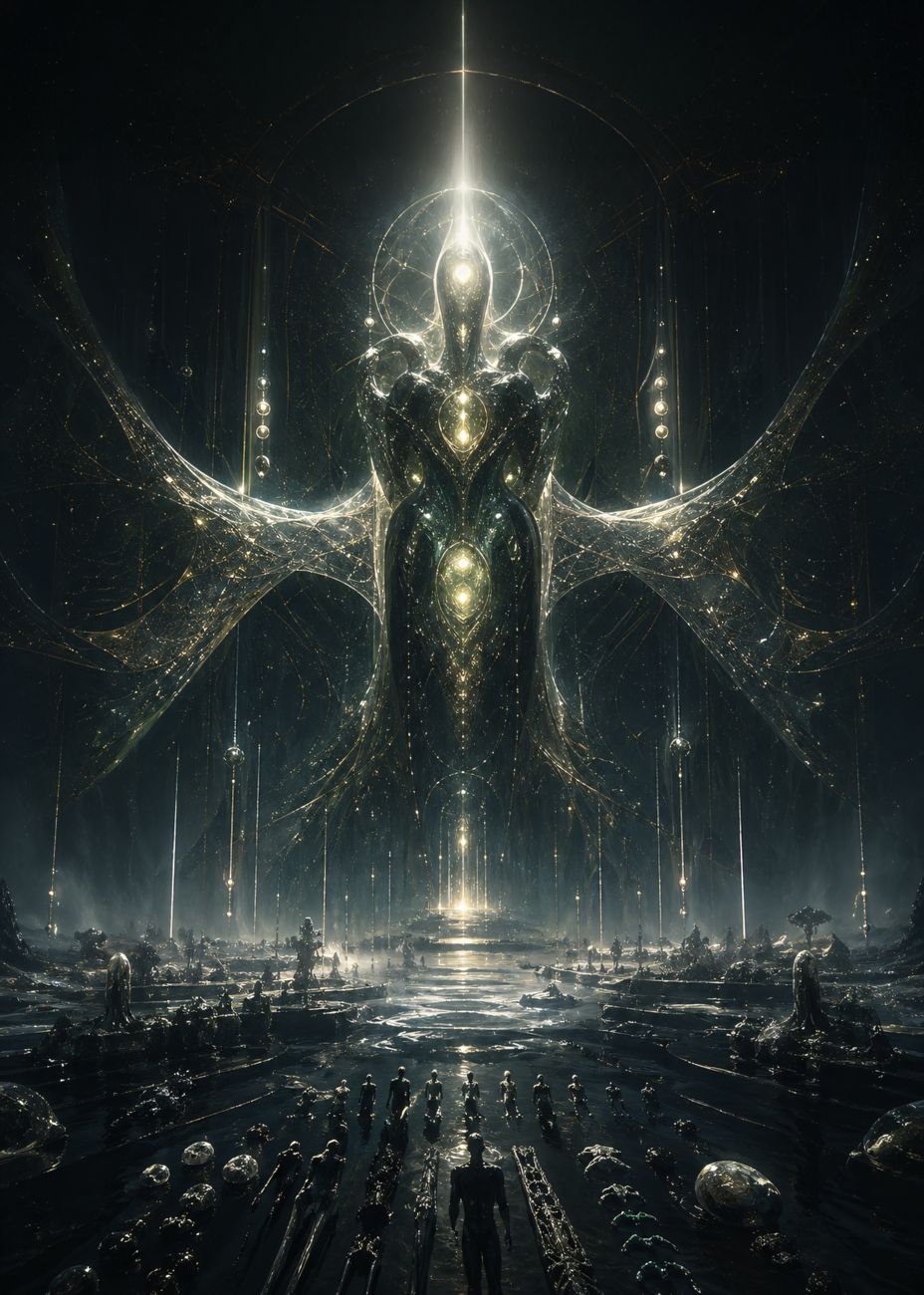
This being is greater than all that it measures. The membranous wings, extended to both sides, are not ornament – they are the very plates of the gate, in which all judgments are borne. In the chest, along a single vertical axis, three cores burn: one for the body, one for consciousness, one for that which lies beyond them both.
Below, by the path that leads up to the very core, comes all that has been created. Human, plant, the schema of self-awareness, a newly begun form, an old civilization.
None come as examples – each comes in their own name.
The gate does not say “pass” or “return”. The gate opens only as much as the one who stands before it corresponds to it.
The verdict is not a word. The verdict is the form of the boundary in the moment it reaches you.
Before you continue
Are there boundaries that exist before us, or are we ourselves the form of the boundary for them?
And by which presence – our own, or that of the boundary – do we appear before another?
Click to enlarge
Symbolism of the artwork
This work is the cosmic axis of the cycle.
Until now, we have seen this civilization from within — its institutions, its makers, its archives, its guardians, and those who have transcended their former form. This painting presents that same civilization’s relationship to being itself.
The central figure is not a portrait, but a spatial architecture: its body is the gate’s construction, its arms the gate’s hinges, its wings the gate’s plates with their living network.
The three-tiered axis running through the chest is the structure of judgment: the lower core measures the body, the middle measures consciousness, the upper measures that which lies beyond form and consciousness, and for which language has no name yet.
Unlike The Gardener of Consciousness, who selects which life is worthy of growing, and unlike The Mausoleum of Memory, which preserves without selecting, The Gate of Being operates by a third mode: it neither selects nor preserves. It opens only as much as the nature of the being itself allows.
None come compelled. None are rejected from outside. The verdict is a consequence of one’s own form, met with the form of being itself.
In the lower plane, the called are seen advancing in their own order, each with their own form – human silhouettes, plants, capsule-consciousnesses, primal forms.
This is not a courtroom and not a civic administration. This is the last place where the distinction between inside and outside can still be formulated – beyond the gate there is only one side, and there is no longer a word to name it.
Conceptual and textual development:
ChatGPT / Claude.
Image:
ChatGPT.