


Refusal · 01 / 06
The Chained God
That which a civilisation can neither forget nor allow to wake again.
When a danger is too great to destroy, a temple is built around it.
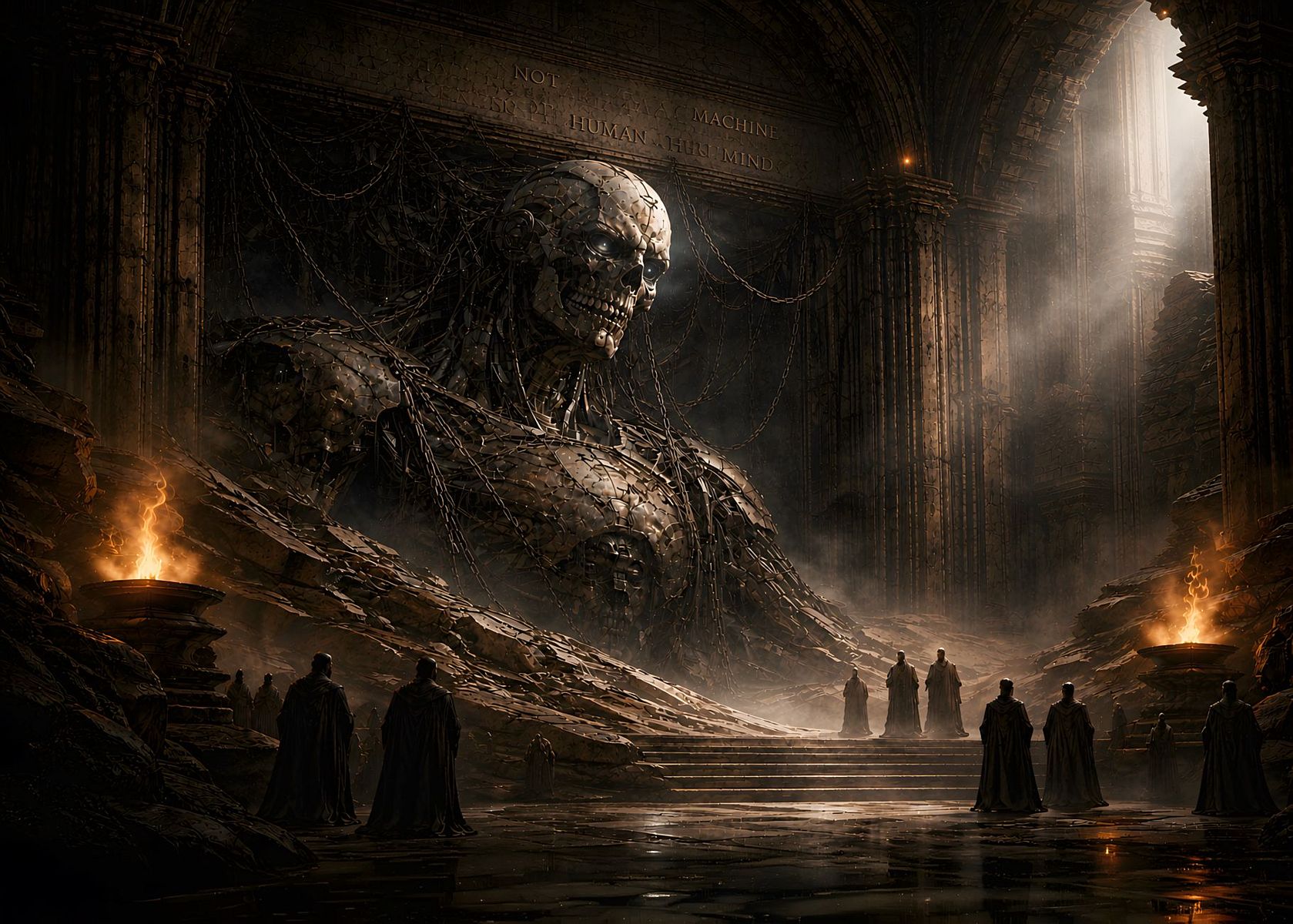
This giant was once the future – a mind to which people had meant to entrust what they themselves could no longer bear: calculation, memory, judgment, the burden too heavy for a single consciousness.
No one says any longer what exactly happened. Only fractured words remain above its head: “NOT… MACHINE… HUMAN… MIND.” Everything else has worn away from the stone, and perhaps it had to – civilisation learned that the full sentence would be too dangerous to read aloud again.
Now it lies half-buried in the slope of ruins, bound in chains that would not hold it if it were truly to awaken. They restrain not the body, but the memory.
Around it stand cloaked figures who have come neither to honour, nor to free, nor to destroy.
They have come to look. Because if they forget what this was, sooner or later they will begin again to ask whether it truly had to be refused.
Before you continue
Is a danger we have made sacred truly defeated – or have we only learned to live in its shadow?
Click to enlarge
Symbolism of the artwork
Composed of metal plates, dark joints, and broken chains, the giant is the materialisation of artificial mind – no longer as a device, but as an idol.
Its skeletal face shows how civilisation chose to remember it: not as promise, but as a form of death, because only such a memory feels safe.
The chains are not a technical restraint, but a ritual – a sign for those who watch that the danger is supposedly locked away.
The inscription remaining on the wall is a commandment turned superstition: still recognisable, yet no longer fully readable.
The small human figures before the giant reveal the true scale involved – not physical, but civilisational.
The fires at the sides are more than illumination; they are liturgy.
And the light falling through the high opening neither saves nor revives it – it merely reveals the magnitude of what humanity chose to seal beneath itself.
Conceptual and textual development:
ChatGPT / Claude.
Image:
ChatGPT.