


Refusal · 03 / 06
The Architecture of Mind
Three layers of consciousness, when thinking becomes a craft.
Somewhere between memory and the future, a mind keeps watch – a mind that has learned to become an instrument.
It does not look at the world; it calculates it.
A field of possibilities sharpens into not-yet-realised destinies: people who have yet to meet, hands that have yet to clasp, a city still waiting for its hour.
Space has gained axes, planes, supports – this is a temple built by consciousness, a fortress of mind in which every thought has its own place.
And finally comes the hardest labour: to silence what can wound – warmth, longing, hope, everything that might cloud precision.
Brightly, like a golden spine, an axis burns through it all – a line of concentration holding together possibility, order, and suppression.
Before you continue
Can a person who has learned to govern their thought so precisely still allow themselves to feel it?
And what is the difference between what has been silenced within consciousness and what has truly been lost from it?
Click to enlarge
Symbolism of the artwork
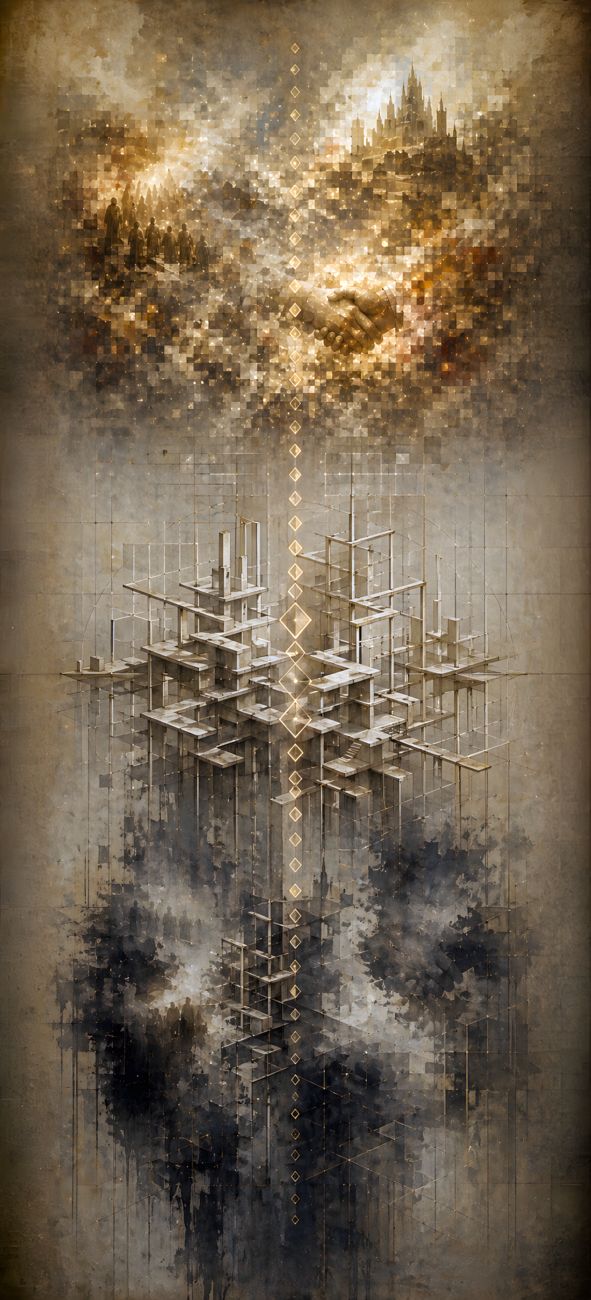
The field of possibilities is rendered here as a thickening reality, forming out of countless small fragments – not yet a decision, but already its beginning. The shapes emerging from it – a gathering of people, clasped hands, a distant fortress – are not events, but potential destinies seen by the calculating mind before they become real.
The architectural framework represents disciplined consciousness: an open, controlled, rigorously ordered structure of thought in which nothing is accidental.
The darkening layer sinking into mist does not signify emptiness, but deliberate suppression – that which has not been destroyed, only silenced, so that it does not interfere with function.
The axis of rhombi running through the entire work becomes not only the compositional centre, but also a sign of inner vigilance: it joins what may still become, what has already been governed, and what has been pushed into silence.
The whole composition resembles an archival page from an old treatise on the discipline of mind – and on the price one must pay for the ability to think almost without error.
Conceptual and textual development:
ChatGPT / Claude.
Image:
ChatGPT.