


In a world that has renounced machines, someone must carry what they will no longer preserve.
Now only the body remains – the last instrument still able to bear such a task. To carry not only knowledge, not only names, not only history, but the whole living line through which civilisation may still recognise itself.
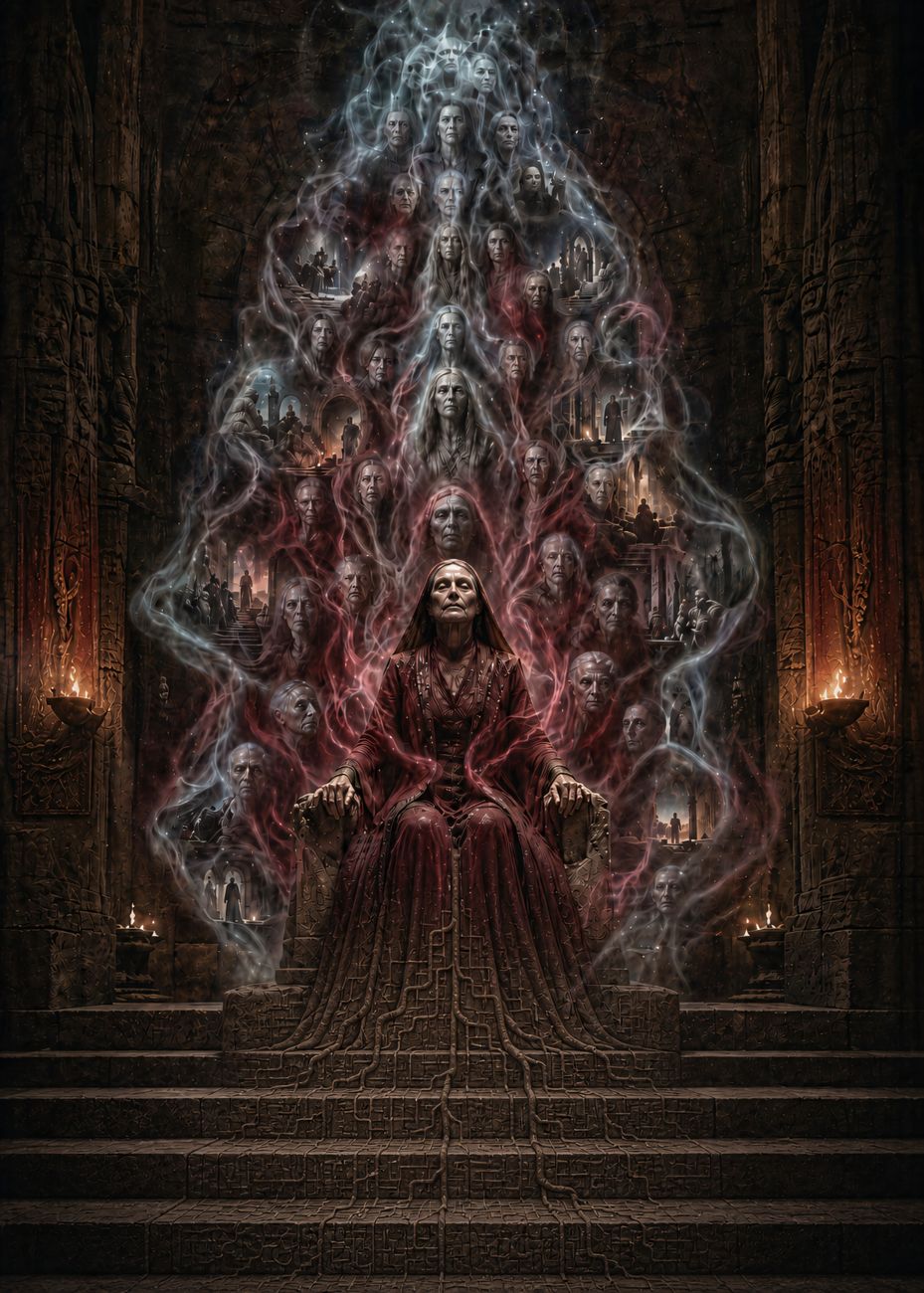
In the depth of the temple, upon a stone throne, sits a woman, like the heart of the painting.
Around her are faces – not a crowd and not a procession, but the memory of a lineage gathered within a single body. Each of them seems at once a person, a memory, and an inner voice. She does not guard them from the outside. She carries them within herself.
Beneath her feet lies an immortalised inheritance, the memory of a lineage inscribed into body and stone.
As long as she is, the world may still have a tomorrow.
Before you continue
What happens to a world when there is no one left to carry its memory?
Does a body that contains many voices still fully belong to itself?
And what does a person choose when renouncing machines – freedom from apparatuses, or the duty to become their substitute?
Click to enlarge
Symbolism of the artwork
The central figure is not a guardian, but an axis – the place where the past meets the possibility of continuing onward.
The ancestral faces rising behind her depict memory not as an archive, but as a living multitude acting within one person at once.
The small scenes visible among the faces and luminous layers remind us that what is inherited is not abstract wisdom, but the experiences, decisions, losses, and endurance of specific lives.
The red and ash-pale streams create a double movement: memory rises from her and returns to her, as if the body were both source and receiver at once.
The root-like patterns passing into the stone and the steps show that this line is held not only in blood, but in the foundation of civilisation itself.
The calm, upward-turned face bears witness not to ecstasy, but to will – the discipline required for a person to carry not only their own life, but the weight of millennia.
Memory here is not a gift. It is a duty.
Conceptual and textual development:
ChatGPT / Claude.
Image:
ChatGPT.