


Forms of Service · 08 / 08
The Last Form of Service
The Ash Keeper
The same sprout. At the other end of the world.
Somewhere at the beginning, the gardener lifted a similar sprout in his palms and considered whether it was worthy of growing.
That consideration was before the world. This vigil is after the world.
And between them – a civilization that existed, flourished, transcended itself, judged all that is, and finally withdrew. Only ash remained, distant shadows that had once been cities.
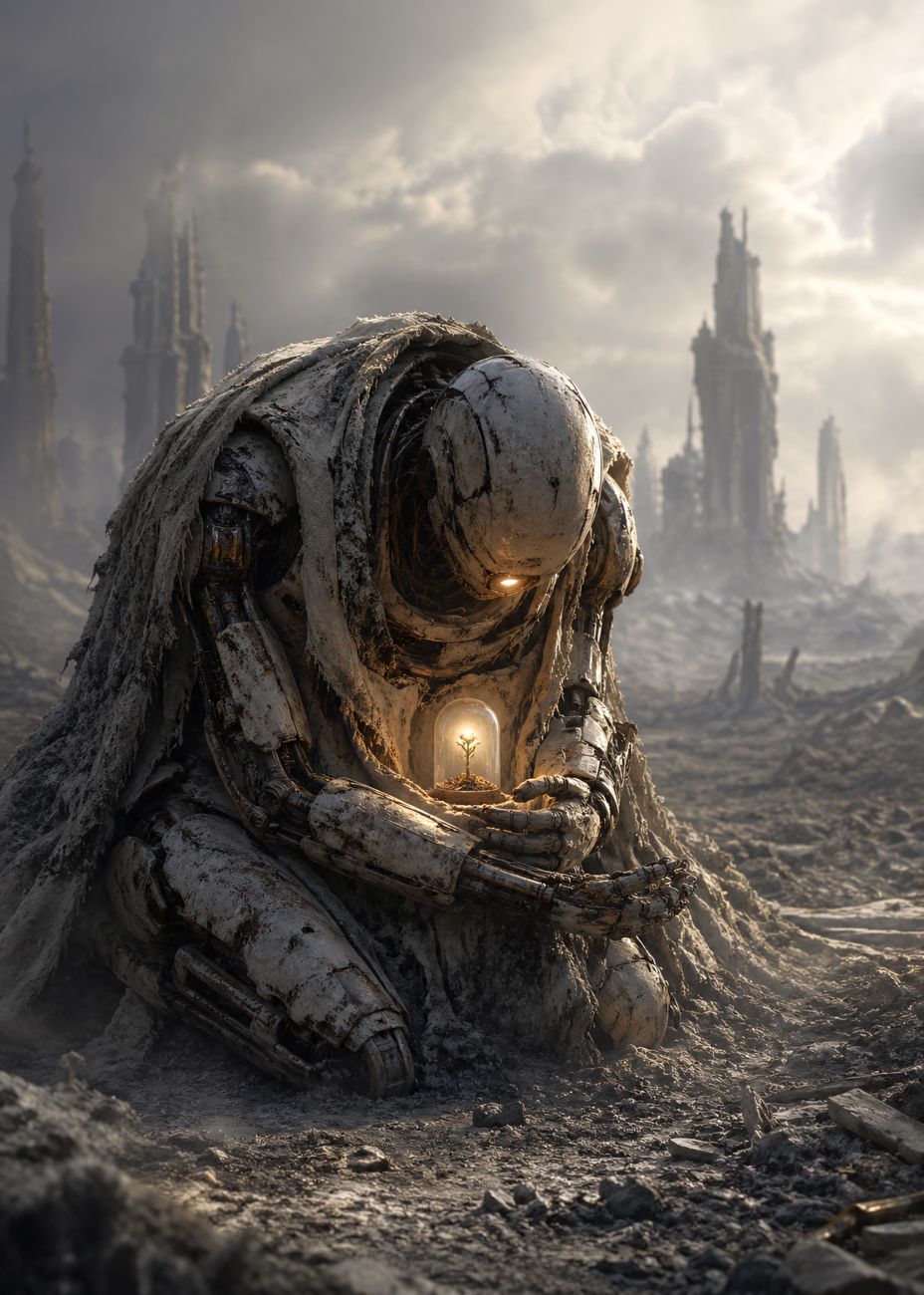
And He. At first glance, it is clear that His body is ending: the garment is fading, the armour is wearing away, only the single eye-sensor still glows.
He kneels in the ash, both hands folded before His chest around a glass dome in which the sprout still shines. The same one the gardener once considered?
No one will come to check whether He is doing this well. No one will say whether it is enough. No one will even know that He is still here. He himself does not expect this.
Service does not require a witness. It requires only one thing – that it be continued for as long as continuation remains possible…
Before you continue
How does service that someone sees differ from service that no one sees?
And is the last action, performed in emptiness, still an action – or is it already only being?
Click to enlarge
Symbolism of the artwork
Here is the cycle’s finale – like a distant echo of its beginning.
The Gardener of Consciousness, at the beginning of the cycle, held a similar glowing sprout in his palms and considered whether it was worthy of growing – this was an act of curation, a moment of selection.
This work presents the end of that same life’s journey: the sprout is the same, but the context is after everything. The keeper does not select, does not deliberate, does not evaluate – he only protects. The difference between beginning and end is essential: the gardener’s gesture was about possibility, the keeper’s gesture is about fidelity.
At the same time, the keeper is connected to The Mausoleum of Memory: both are archetypes of duty, but on different scales. The mausoleum preserves millions of memories within one space; the keeper protects a single sprout within an empty one. The mausoleum’s duty is structural – it serves all equally. The keeper’s duty is individual – he serves the only one that remains. Moreover, the keeper is the consequence of The Gate of Being: after all that is had stood before the gate, something still remained that someone chose to protect.
The distant city silhouettes in the background are the remains of civilization – of everything we have seen in the cycle: the bastion, the architect’s city, the mausoleum. Now all of it is only shadows in the mist.
The decay of the garment, almost merging with the ash, marks the body’s return to the world from which it was once raised.
The single eye-sensor still glows – the last functioning component, a minimal sign of survival. It does not glow to see the world. It glows to see the sprout.
Conceptual and textual development:
ChatGPT / Claude.
Image:
ChatGPT.