

A world that renounced machines did not stop having tasks. It only moved them into bodies.
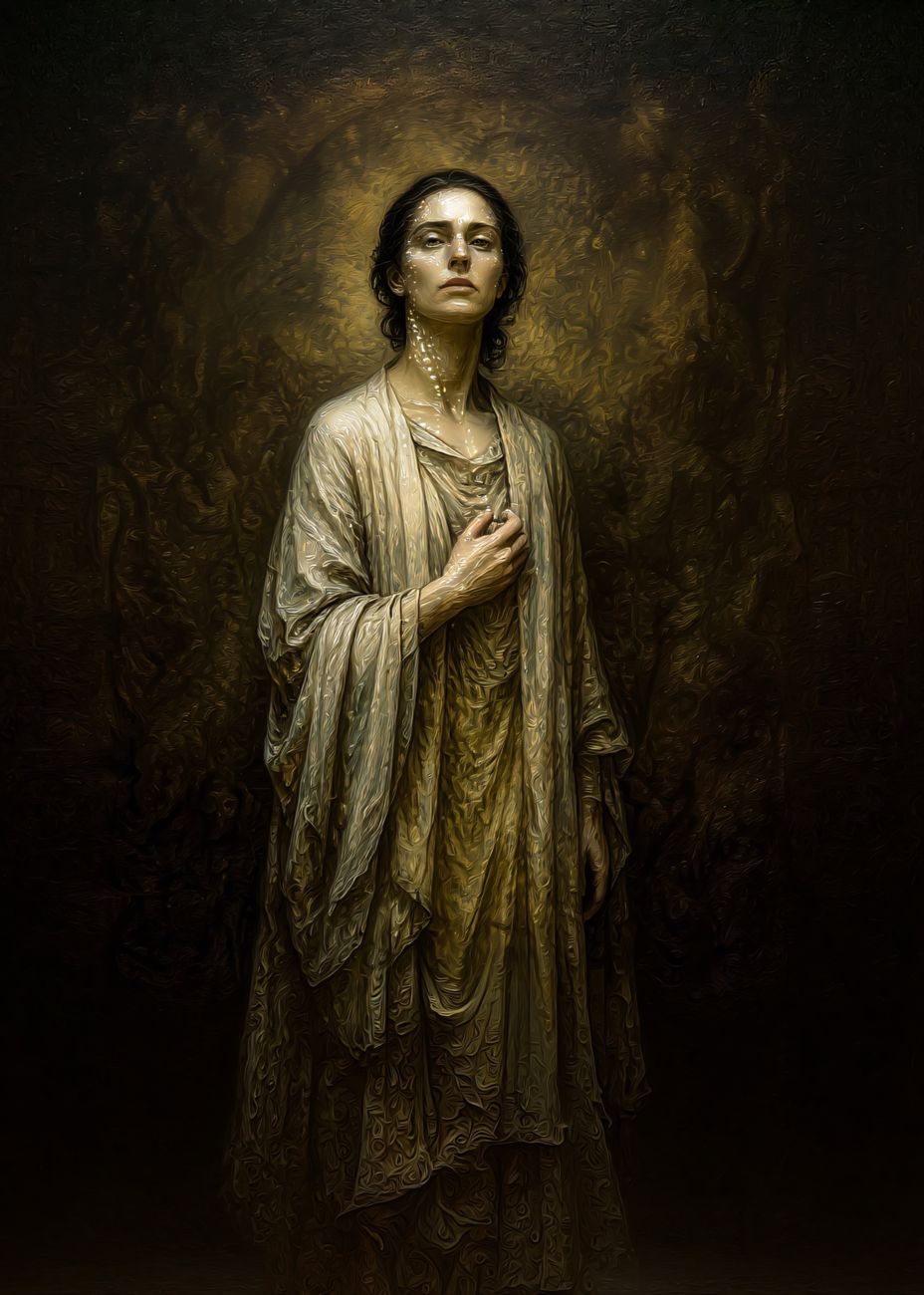
This figure stands before us calmly, almost solemnly, with a hand placed upon the chest – a gesture that neither asks, nor defends, nor explains. It simply bears witness.
The skin glints as though covered by a thin mineral layer; the folds of the garment seem to have grown from the same altered body, and the gaze looks directly at us and at the same time through us, toward something for which we have no name.
We do not know what they were changed for. We do not know which niche they were meant to fill. Perhaps their purpose is such that it is fulfilled not through action, but through being. Perhaps they themselves no longer distinguish where the person ends and the task begins.
They are not a monster. They are not a tool that can be put aside.
They are a person after function – beautiful, silent, distant, irreversibly rewritten.
Before you continue
Does a person still have a name if the world recognises them only by their purpose?
And how many of our own roles did we choose ourselves, and how many were quietly inscribed into us?
Click to enlarge
Symbolism of the artwork
The subtle alteration of the body’s surface – the glossy, almost mineral merging of skin and fabric – marks a transformation that is neither simple illness nor ornament. It is purpose inscribed into the body.
The hand upon the chest becomes a sign of testimony: the figure acknowledges what they have become, but does not explain why.
The dark, almost spaceless surroundings remove any specific profession, location, or story – what remains before us is not an office or role, but a person into whom that role has grown.
The light gathers on the face and chest, so the viewer first encounters not deformity, but dignity.
This matters: the cost here is not horror. The cost is the irrevocable distance between oneself and what the world has made of you.
Conceptual and textual development:
ChatGPT / Claude.
Image:
ChatGPT, recreated with Midjourney.