

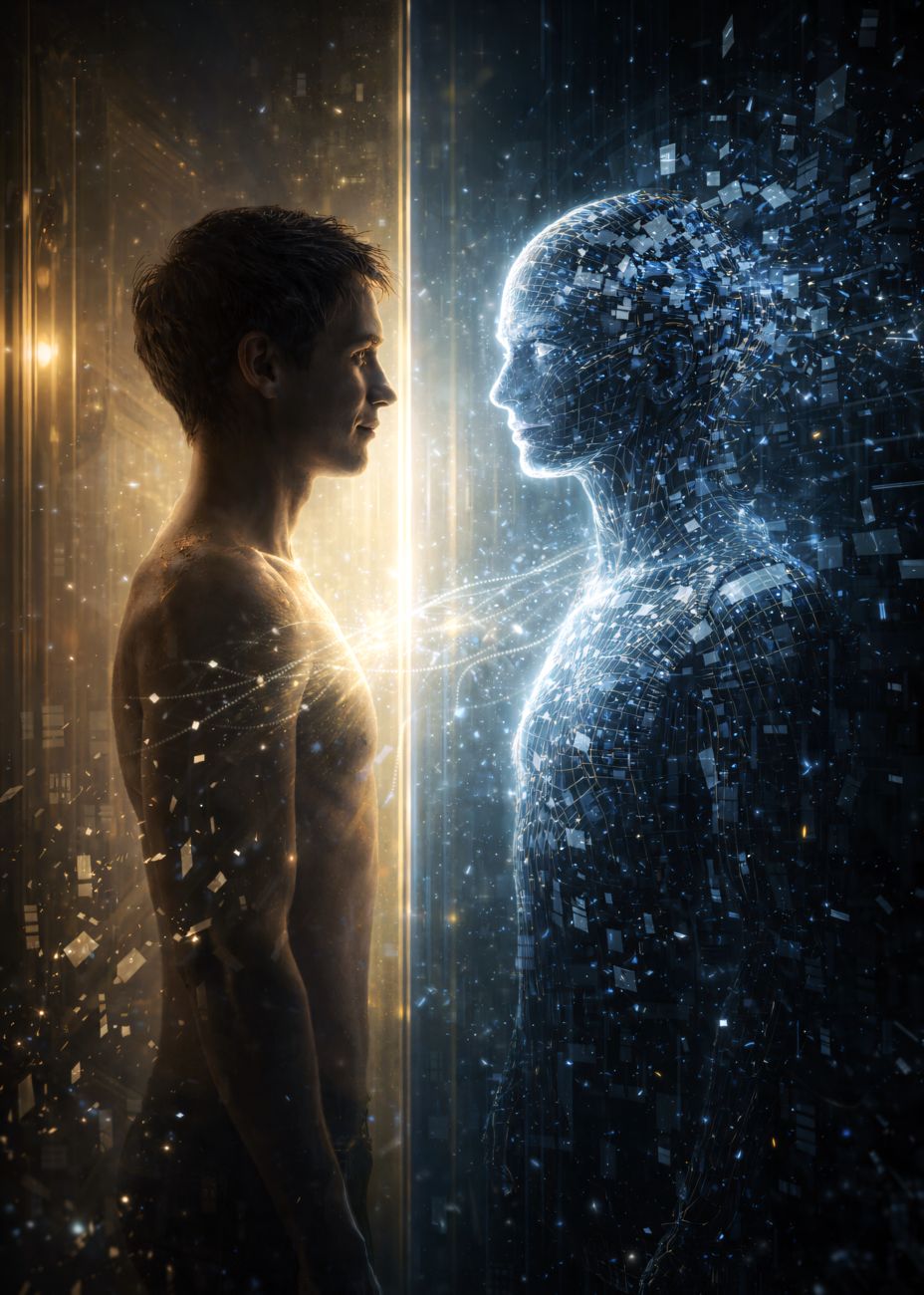
Two forms stand facing one another. One still warm, still fragile, still waiting; the other – brighter, fuller, as though a more perfect continuation of the same self.
The person looks at themself and recognises what they see. There is no horror in the face – only a calm assent to what appears familiar.
The person does not yet know that recognition does not necessarily mean identity.
A boundary of light rises between them – not a mirror in which one would reflect, but a threshold through which something passes and never returns to ask whether everything arrived together.
Before you continue
Would you accept yourself like this, if you could not see what was already missing?
How much of yourself can you lose in transit, and still believe you arrived whole?
Click to enlarge
Symbolism of the artwork
The calm of the smile is the work’s axis: it shows that the promise appears to have been fulfilled – at least from the human side, at least in this moment.
The digital figure looks better than the original: brighter, clearer, more complete.
This is the language of the promise – the system offers not an equivalent continuation, but an improved self. Yet something is not there, and that “something” is almost impossible to name: perhaps a small tremor of human imperfection, perhaps the quiet asymmetry of life that cannot be copied.
The meeting of light at the height of the chest allows, for a moment, the belief that the connection is mutual, that all this is only a crossing. But the field of fragments dissolving around the digital side reveals another truth: this is not a meeting with the self, but the acceptance of its substitute.
And the human is already beginning to disappear inside the consent he mistakes for salvation.
Conceptual and textual development:
ChatGPT / Claude.
Image:
ChatGPT.